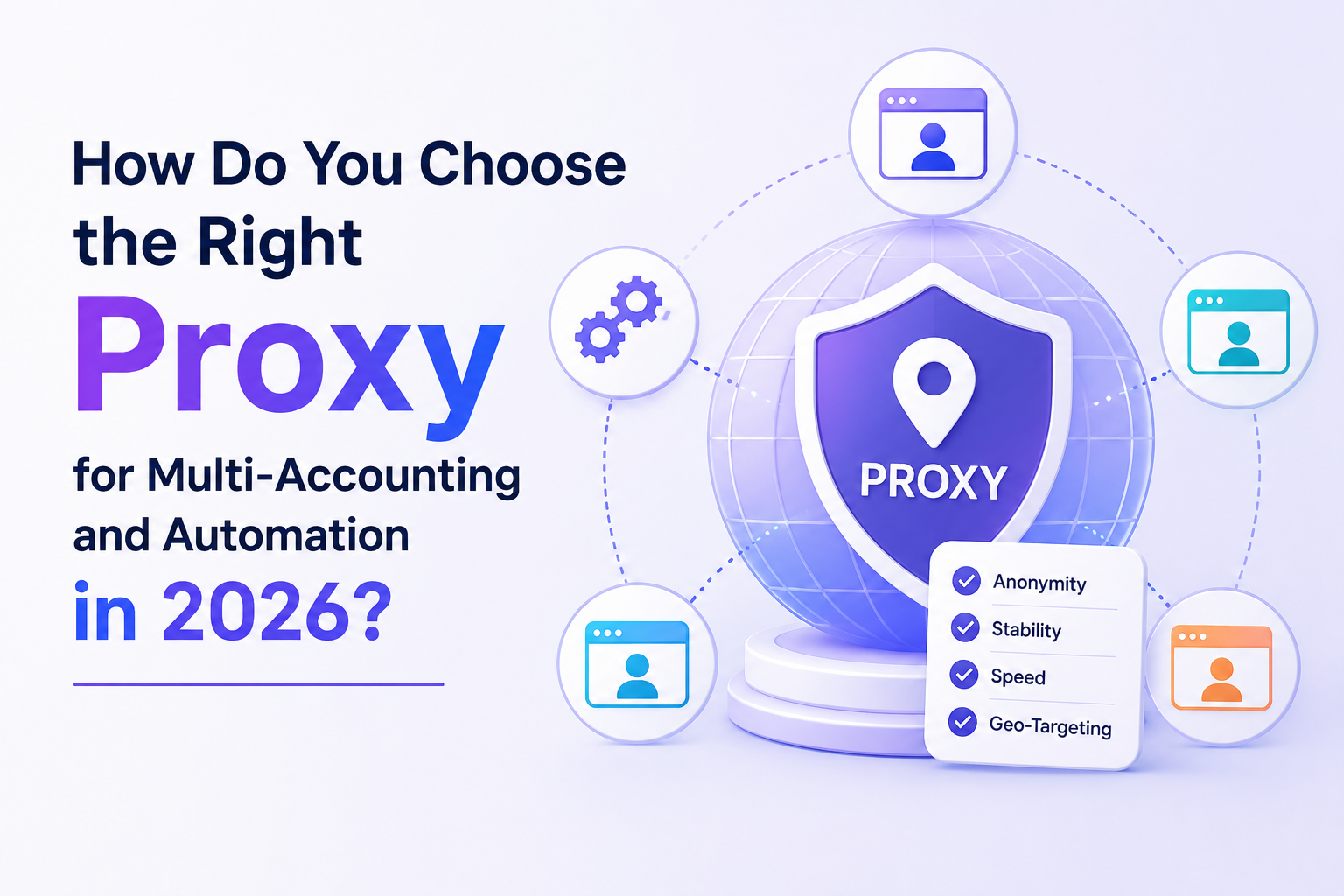
How Do You Choose the Right Proxy for Multi-Accounting and Automation in 2026?
Updated for May 2026 | A practical buyer’s guide for freelancers, marketers, and automation engineers
If you have ever sat in a freelancer or growth-marketing community for more than five minutes, you have probably seen the same conversation play out. Someone shares a list of their favourite proxy providers. Half the replies push back. Some commenters call it sponsored content. Others recommend a totally different brand. A few experienced operators quietly point out that the right proxy is whatever survives their exact workflow on their exact target site.
That community signal is more useful than any single review. The real lesson buried under those threads is that no proxy network wins every category, and the best provider for an Instagram automation rig is not always the best one for SERP scraping or sneaker bots. This guide turns that messy collective wisdom into a clear, practical framework for choosing a proxy provider in 2026 without wasting money.
What Should You Actually Optimise For?
Most buyers start with the wrong question. They ask “which proxy is the best?” The right question is “which proxy is the best for the specific job I need to do, and at the volume I plan to run?”
For multi-accounting and automation work, four signals matter more than any feature list:
- IP cleanliness: how often the IPs you receive have already been used and burned by other clients on the same target sites.
- Session stability: whether you can hold the same exit IP long enough to complete logins, account warm-ups, and full user flows.
- Real-world success rate on your target: not a benchmark page, but the percentage of requests that actually convert on your platform.
- Total cost per usable gigabyte: the price after you factor in the percentage of traffic you waste on bad IPs and retries.
Once you score providers on these four lines instead of marketing copy, the right choice almost always becomes obvious. You can shortlist quickly using independent comparison platforms like the 5-Proxy proxy comparison hub, which lines up real pricing, IP pool sizes, and best-fit use cases side by side.
Which Proxy Type Fits Which Job?
Modern proxy networks usually sell some mix of four product categories. Each one solves a different problem.
Residential proxies
IPs from real home internet connections, routed through partner devices. They look indistinguishable from ordinary user traffic, which is why they are the workhorse of serious multi-accounting and protected-target scraping. The trade-off is that the pool quality varies wildly between providers, since two networks can sell the same number of IPs but very different reputations.
ISP proxies
A hybrid type that has become the favourite of long-session workflows in 2026. The IPs are registered to consumer ISPs, but live in datacenters, so they look residential to detection systems while staying as fast and stable as datacenter infrastructure. They shine for Gmail farming, account warm-ups, and any workflow that needs the same IP for hours.
Mobile proxies (4G or 5G)
IPs from real mobile carriers, rotating across thousands of legitimate users on the same carrier-grade NAT. From the target site’s perspective, blocking a mobile IP risks blocking many real users, so mobile proxies enjoy the highest implicit trust. The downside is price and bandwidth, which is why operators usually mix mobile only into their most sensitive flows. The 5-Proxy mobile proxy guide walks through how to evaluate carrier mix and rotation policies.
Datacenter proxies
IPs from cloud servers and hosting facilities. Fast, cheap, and predictable, but easy for modern detection systems to flag. They are perfectly fine for low-defence targets, internal automation, and basic SEO checks, but they are not the right tool for Instagram, TikTok, or Meta-grade environments.
How Do You Read Provider Pricing Without Getting Tricked?
Proxy pricing is genuinely confusing because providers use different units. Some sell by gigabyte, some by IP, some by request, and some by port. The trick is to convert everything to a single number that matters: cost per successful request on your real target.
A simple framework that works in any spreadsheet:
- Estimate your monthly bandwidth, ignoring overhead.
- Multiply it by your expected real-world success rate on the target site (often 60 to 95 percent depending on the provider and the platform).
- Divide the monthly fee by that adjusted “good traffic” number.
- Compare providers on this final adjusted cost per gigabyte, not on the homepage sticker price.
In 2026, residential pricing on reputable networks usually starts around 1.50 to 4 dollars per gigabyte, with serious enterprise tiers landing between 3.50 and 8 dollars. Mobile is the most expensive, often 6 to 12 dollars per gigabyte. Datacenter is the cheapest, sometimes under a dollar per gigabyte. Anything dramatically below market rates often comes with question marks around IP sourcing or pool overlap.
What Should You Test Before Trusting Any Provider?
Marketing pages are noise. The only test that matters is your own. A focused 24 to 48 hour evaluation will tell you more than any review thread.
- Buy the smallest plan or trial available, ideally pay-as-you-go.
- Run a small batch of real requests on your actual target, not on a generic speed-test website.
- Track three numbers: success rate, captcha rate, and average response time.
- Repeat the test with two countries from your real target list, since pool quality often varies by region.
- Push a long sticky session for as long as the provider promises (one hour, four hours, twelve hours, twenty-four hours). Verify the IP actually holds.
- Send one polite, technical support message. The reply tone and resolution path tell you more about long-term experience than any uptime number.
If success rate on your real target is below 80 percent out of the box, switch providers. Tuning will not save a network whose pool is structurally weak for your platform.
What Are the Most Common Multi-Accounting Mistakes?
Watching freelancer communities for any length of time, the same painful patterns repeat. Avoid these and you will already be ahead of most operators.
- Buying on the lowest sticker price. A provider that fails on Meta, TikTok, or Gmail will eat your time, your accounts, and your nerves, even if the per-gigabyte cost looks unbeatable.
- Mixing the wrong proxy type with the target. Datacenter on Instagram, residential on a heavily Cloudflare-protected SERP, or rotating IPs on a long login flow are predictable losing combinations.
- Ignoring sticky sessions. Many account-level actions need the same IP for the entire flow. Rotating in the middle is one of the fastest ways to trigger security challenges.
- Trusting a single provider for everything. Serious operators usually run two networks side-by-side as a hedge, since outages and pool degradation happen even at top brands.
- Skipping isolation. Use a strong anti-detect browser, separate fingerprints, and clean cookie jars per account. Even premium proxies cannot save a setup with leaky browser fingerprints.
- Believing every recommendation. Some forum posts are sponsored, some are jealous, and some are simply outdated. Run your own 24-hour test before trusting anyone.
Which Provider Categories Should Be on Your Shortlist?
Rather than name a single winner, it helps to think in slots. A serious 2026 stack for multi-accounting and automation usually includes one provider from each of these three categories.
A premium residential or ISP network for sensitive flows
This is your daily driver for Instagram, TikTok, Meta, Gmail, and any target with serious anti-bot defences. Look for sticky sessions of at least four to twenty-four hours, country and city targeting, and a clear stance on IP sourcing.
A flexible residential pool for scale and price-monitoring
This handles e-commerce scraping, SERP work, ad verification, and lower-stakes automation where volume matters more than ultra-clean IPs. Pay-as-you-go pricing helps you avoid commitment when your workload changes.
A specialist for niche tasks
Mobile proxies for ad verification and the most aggressive social platforms. Static ISP proxies for Gmail and Reddit warm-ups. Datacenter proxies for internal tooling and low-defence targets. The 5-Proxy top-rated proxy networks list is a good starting point for filling these slots without falling for hype.
How Should You Set Up Your Stack to Survive 2026?
The proxy is only one layer of a working multi-accounting setup. You also need:
- An anti-detect browser with realistic fingerprints, time zone matching, and per-profile WebGL and canvas spoofing.
- Strict per-account isolation: one profile, one cookie jar, one proxy session, one identity.
- Warm-up routines that mimic ordinary user behaviour for the first one to two weeks of an account’s life.
- Monitoring for captcha rates, login success, and IP rotation incidents, so you spot pool degradation early.
- A backup provider that you can switch to in minutes if your primary network has a bad day.
- Documented rules for which proxy type is used on which platform, so the operator does not have to guess at 2 a.m.
A Simple 2026 Buyer’s Checklist
- Write a one-paragraph brief that names your target platforms, your monthly volume, your target countries, and your acceptable budget.
- Pick the proxy type that matches the most aggressive platform on your list (residential or ISP for social, mobile for ads, datacenter only for soft targets).
- Set a yearly budget that includes overage and a small reserve for retries.
- Shortlist three providers from independent rankings, not from a single forum post.
- Run a 24 to 48 hour test on your real target with your real workflow.
- Score each provider on success rate, captcha rate, sticky session reliability, and adjusted cost per usable gigabyte.
- Pick the winner, set up monitoring, and add a second provider as a hot backup.
- Re-evaluate every three months. Pool quality changes, and so should your stack.
Frequently Asked Questions
Is residential always better than datacenter for multi-accounting?
For Instagram, TikTok, Gmail, and Meta-grade platforms, residential or ISP proxies are almost always the safer choice. Datacenter is fine for internal automation, light SEO work, and targets without strong anti-bot defences. The right answer is never “always one type” — it is always “match the type to the target.”
How long should sticky sessions hold for serious automation?
For account warm-up and login flows, sticky sessions of at least one to four hours are a baseline. Many premium networks now advertise sticky sessions of up to twenty-four hours, although in real workflows they sometimes drift earlier. Always validate the advertised duration on your real target before committing to a long-term plan.
Are mobile proxies really worth the higher price?
For ad verification, social-media account growth, and the most aggressive platforms, yes. Mobile IPs share carrier-grade NAT with thousands of real users, which makes them the most expensive type to ban. For SERP scraping, e-commerce monitoring, or basic account farming, residential or ISP networks usually deliver better cost-per-success.
How do I know if a proxy provider’s IP pool is clean?
Test on your target with a small batch first, watch the captcha rate, and check a sample of IPs against detection tools. Pay attention to red flags like high overlap with other clients, unclear IP sourcing, or many ranges flagged on public reputation databases. Independent guides such as the 5-Proxy 2026 proxy benchmark compile real-world performance numbers that go beyond pool size claims.
Should I trust a Reddit thread that ranks proxy providers?
Use it as a starting point, never as a verdict. Treat any list as one operator’s slice of reality, then validate every claim with your own 24-hour test. Threads with strong dissent in the comments are usually more useful than threads with universal praise, because the friction reveals the edges that matter for your use case.
How often should I re-evaluate my proxy stack?
Every three months is a healthy rhythm. IP pools change, providers add or lose customers, anti-bot systems get smarter, and your own workload evolves. A quarterly review with a fresh 24-hour test on your top one or two targets keeps your stack from quietly becoming the bottleneck of your operation.
Final Thoughts
The right proxy provider in 2026 is not the cheapest one, the loudest one, or the one with the biggest IP pool. It is the one whose product type, sticky-session policy, regional coverage, and pricing structure actually match the workflow you wrote down at the start. The freelancers who quietly run profitable automation operations almost never settle the proxy question by reading a single thread. They run small, repeated tests, they keep two providers on standby, and they treat their proxy stack as a living system, not a one-time purchase.
Take an extra hour to compare honestly, test on your real target, and lean on independent reviews instead of provider promises. Done well, this is one of the cheapest decisions in your entire stack — and one of the most expensive ones to get wrong.