⚡ Quick Answer: Static ISP vs. Rotating Residential Proxies
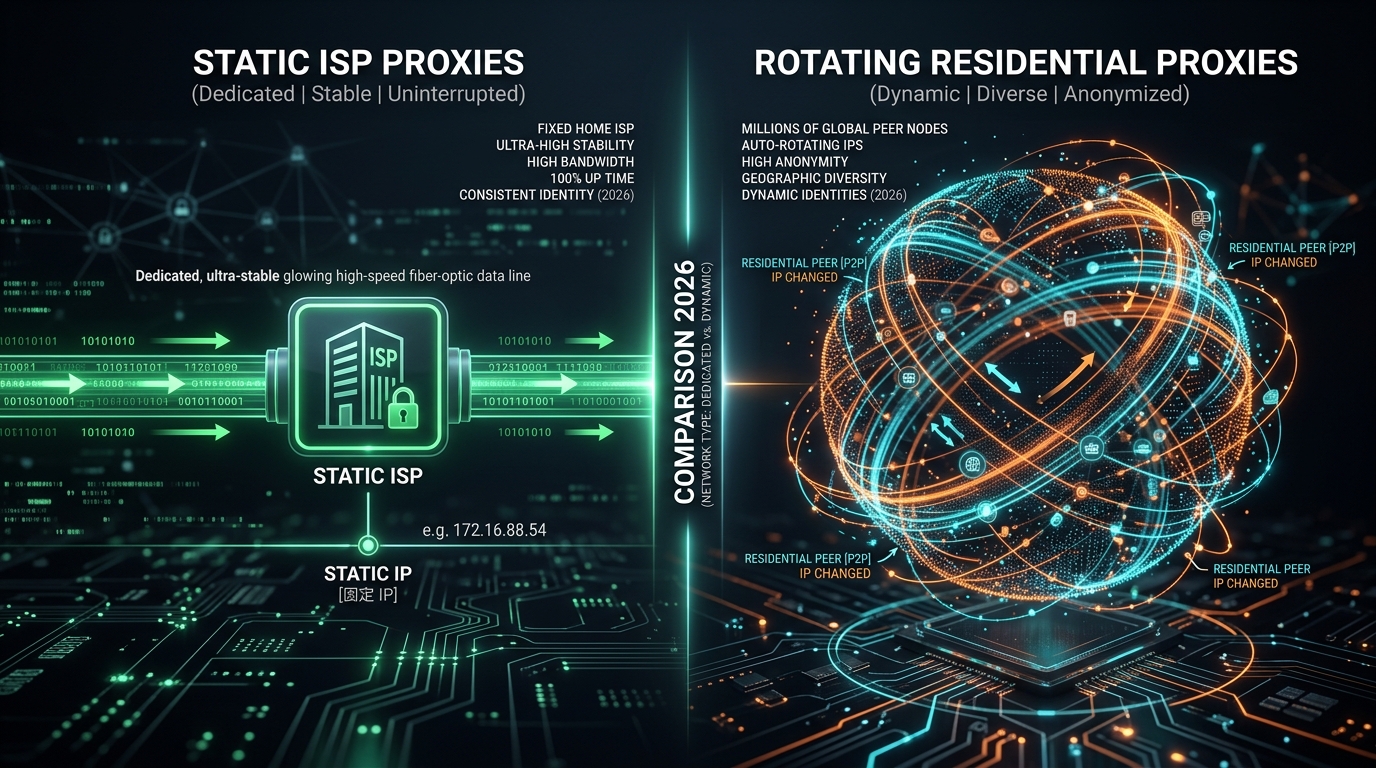
The Core Difference: Choose Static ISP proxies if your workload requires persistent login sessions, zero IP disconnections, and maximum download speeds (such as multi-accounting, sneaker copping, managing ad campaigns, or financial accounts). Choose Rotating Residential proxies if your goal is high-volume web scraping, competitive price intelligence, or bypassing aggressive anti-bot rate limits across millions of stateless URLs.
- Static ISP Proxies (Static Residential): Enterprise datacenter hosting combined with legitimate consumer ASNs (AT&T, Comcast, Verizon). Provides 100% uptime, 1 Gbps+ speeds, zero IP rotation, and unlimited bandwidth billing per IP.
- Rotating Residential Proxies: Real peer-to-peer consumer devices connected via home Wi-Fi. Swaps IP addresses per request or every 5–30 minutes. Offers massive global IP pools (30M–100M+ IPs) billed on bandwidth consumption per gigabyte.
- Decision Rule: If an IP change breaks your session, buy a Static ISP proxy. If an IP block breaks your crawler, buy a Rotating Residential proxy.
When engineering an automated infrastructure—whether for web scraping, competitive intelligence, e-commerce monitoring, or multi-account management—selecting the right proxy architecture is the single most critical technical decision. In 2026, two dominant proxy categories account for over 85% of professional proxy spend: Static ISP Proxies (frequently referred to as Static Residential proxies) and Rotating Residential Proxies.
While both proxy types display legitimate residential Autonomous System Numbers (ASNs) that bypass basic security blacklists, their underlying physical topology, hosting infrastructure, session mechanics, and billing models are fundamentally opposite. Purchasing the wrong architecture wastes development hours and budget: routing large-scale scraping through static IPs leads to rapid subnet rate-limiting, while managing sensitive advertising profiles with rotating pools triggers permanent account suspension.
In this authoritative architectural evaluation, we compare Static ISP and Rotating Residential proxies across network routing, IP reputation scoring, session persistence, latency benchmarks, and commercial pricing models, helping you determine exactly which architecture fits your operational needs.
1. Architectural Breakdown: How Static ISP and Residential Proxies Work
To evaluate which proxy type your application requires, you must examine how network packets route through the internet and how target firewalls inspect incoming connection metadata.
Static ISP Proxies: The Hybrid Architecture
A Static ISP proxy represents a sophisticated architectural hybrid: it combines the raw speed, 99.9% uptime, and low latency of enterprise datacenter servers with the high trust rating of residential Internet Service Providers. Proxy providers negotiate commercial agreements directly with major consumer telecom operators (such as AT&T, Comcast, Charter Spectrum, Verizon, or Vodafone) to lease official IP ranges registered under consumer ASNs.
These IP addresses are announced via BGP (Border Gateway Protocol) routing directly from enterprise server facilities. When a website inspects the connecting IP, the IP2Location or MaxMind database identifies a residential subscriber line. However, because the physical server is hosted in an enterprise Tier-IV datacenter, the connection benefits from dedicated 1 Gbps to 10 Gbps fiber uplinks, zero battery throttling, and continuous availability.
Rotating Residential Proxies: The Peer-to-Peer Global Mesh
Rotating residential proxies operate on a completely decentralized, peer-to-peer (P2P) network model. The IP addresses originate from authentic physical hardware—laptops, desktop computers, smart TVs, and home Wi-Fi routers—owned by real everyday consumers across more than 195 countries.
These consumers opt into proxy sharing networks via software development kits (SDKs) embedded in utility applications or compensated sharing platforms. When your crawler dispatches an HTTP request to a residential proxy gateway, the gateway intercepts the packet and routes it through an active peer node in your target country or city. Because millions of consumers are connected simultaneously, the gateway can swap your outgoing IP address on every single request or hold a sticky session for 5 to 30 minutes before the host machine disconnects.
2. Comprehensive Comparison Matrix: Static ISP vs. Rotating Residential
Below is a direct engineering benchmark comparing the operational capabilities of both proxy architectures across core technical metrics:
| Technical Metric | Static ISP Proxies | Rotating Residential Proxies |
|---|---|---|
| IP Persistence & Session Duration | Permanent (100% Static) Same IP for weeks, months, or years |
Dynamic / Ephemeral Per-request or sticky (5–30 mins max) |
| Average Latency (RTT) | Ultra-Low (20ms – 70ms) Datacenter fiber backbone |
Moderate (350ms – 1,200ms) Dependent on home Wi-Fi peer stability |
| Bandwidth & Speed Limits | Uncapped / High Bandwidth 1 Gbps – 10 Gbps lines, no per-GB metering |
Metered Bandwidth Billed per Gigabyte ($1.75 – $5.04/GB) |
| IP Pool Size & Diversity | Limited (Thousands to Tens of Thousands) Assigned as dedicated IP blocks |
Massive (30M – 100M+ IPs) Spans 195+ countries and millions of subnets |
| Detection & Blacklist Risk | Higher on Aggressive Scraping If the IP gets banned, the single line is dead |
Near-Zero on Scraping Immediate auto-rotation to fresh peer nodes |
| Pricing Model | Flat monthly fee per IP ($1.50 – $3.50/IP/mo) | Pay-as-you-go or tier per GB ($2.00 – $5.00/GB) |
3. The Four Core Architectural Differentiators Decoded
1. IP Reputation and ASN Classification Mechanics
Modern anti-bot engines (including Cloudflare, DataDome, Akamai, and PerimeterX) assign a trust score to every connecting client based on its Autonomous System Number (ASN). When an IP contacts a web server, the security system performs an instantaneous lookup:
- Datacenter ASNs (e.g., AWS AS16509, Hetzner AS24940): Identified as synthetic cloud servers. Blocked by default on high-security storefronts.
- Static ISP ASNs (e.g., Comcast AS7922, AT&T AS7018): Identified as fixed residential broadband lines. Assigned maximum trust because legitimate homeowners browse through these networks.
- Residential P2P ASNs: Identified as genuine local consumer providers. Assigned high trust, but individual peer IPs occasionally suffer from prior abuse scores if another user in the P2P pool scraped recklessly.
2. Session Persistence: Sticky Sessions vs. True Static IP
A frequent point of confusion is the difference between a “sticky residential proxy” and a “static ISP proxy”.
In a rotating residential proxy network, a sticky session is maintained by the gateway router, which attempts to route consecutive requests through the same consumer device for 10 or 30 minutes. However, because that consumer can close their laptop, turn off Wi-Fi, or put their phone to sleep at any second, sticky residential sessions can drop unexpectedly. If your crawler is in the middle of a 5-step banking verification or checkout flow, an abrupt IP change will invalidate your session cookies.
In contrast, a Static ISP proxy never drops. The IP address belongs to an enterprise server that remains online 24/7/365. You can maintain an unbroken login session for six consecutive months without the IP ever changing.
3. Throughput, Concurrency, and Bandwidth Economics
The financial economics of your project dictate which proxy architecture is sustainable:
When Bandwidth Costs Make Rotating Proxies Prohibitive:
If your project involves downloading high-resolution product images, streaming video assets, or parsing massive JavaScript-heavy single-page applications, bandwidth consumption escalates rapidly. Scraping 500 GB of asset data on a rotating residential pool at $3.50/GB costs $1,750. Running that exact same workload across 10 dedicated Static ISP proxies with unlimited bandwidth costs approximately $25 to $35 total per month.
When Rate Limiting Makes Static Proxies Ineffective:
If your project requires scraping 1,000,000 product pages from Amazon, Walmart, or Nike within a 2-hour window, you cannot route those requests through 20 static ISP proxies. The target server’s rate-limiting firewalls will ban your 20 IPs within the first 60 seconds. To bypass strict request-per-minute thresholds, you must distribute requests across tens of thousands of rotating residential IPs.
4. Use-Case Decision Framework: Which One Do You Need?
To eliminate ambiguity, review this production decision matrix matching specific industry workflows to their ideal proxy architecture:
Scenario A: Social Media Management & Paid Ad Buying (Meta, TikTok, Google)
Winner: Static ISP Proxies.
Platforms like Facebook Business Manager and TikTok Ads monitor connection stability. If an account administrator logs in from three different IP addresses within an hour, the security system detects an account takeover attempt and freezes ad spend. Static ISP proxies provide the fixed, high-trust consumer IP required to keep ad accounts active indefinitely.
Scenario B: E-Commerce Web Scraping & Real-Time Price Intelligence
Winner: Rotating Residential Proxies.
Large-scale e-commerce scrapers must harvest millions of catalog listings without triggering anti-bot rate limits. Rotating residential proxies swap IP addresses on every single request, ensuring that no single IP address exceeds the target website’s threshold. Furthermore, rotating pools allow you to target specific ZIP codes and cities to extract localized pricing.
Scenario C: Sneaker Copping, Ticket Purchasing & Limited Product Drops
Winner: Static ISP Proxies.
During a high-heat product release on Shopify, Nike SNKRS, or Ticketmaster, milliseconds matter. Rotating residential proxies suffer from high latency (500ms+) and sudden peer drops during checkout. Static ISP proxies deliver 100 Mbps+ throughput with sub-50ms ping times, allowing bot tasks to reach the checkout queue first and complete the purchase without mid-transaction IP swaps.
Scenario D: E-Commerce Storefront Stealth Accounts (eBay, Amazon, PayPal)
Winner: Static ISP Proxies.
Operating backup or stealth merchant accounts requires absolute fingerprint and network consistency. A static residential IP assigned permanently to an anti-detect browser profile (like AdsPower or Multilogin) simulates a real merchant operating from home, completely bypassing marketplace fraud algorithms.
5. How to Audit and Verify Proxy ASN & IP Reputation
Before deploying either Static ISP or Rotating Residential proxies into production, network engineers must audit their IP health. Low-quality proxy brokers often market recycled datacenter IPs with forged whois records as ‘ISP proxies’. Use the terminal commands and Python audit script below to inspect the true network characteristics of your proxy line:
Terminal Verification with cURL
Execute this command to inspect the Autonomous System Number and connection type reported by global threat intelligence feeds:
Inspect the output JSON parameters:
org: Must display a consumer broadband provider (e.g.,AS7922 Comcast Cable Communications, LLCorAS7018 AT&T Services, Inc.). If it displays a cloud hosting company like DigitalOcean, OVH, or M247, the proxy is an unmasked datacenter IP.company.type: Must declareisp. If it displayshostingorbusiness, anti-fraud algorithms will score the connection as suspicious.
6. Subnet Cleanliness & BGP Peering: The Hidden Trap of Cheap Static IPs
When shopping for Static ISP proxies, price disparities are often striking: some providers charge $1.20 per IP while others charge $4.00 per IP. The price difference rarely stems from server hardware; it is almost entirely driven by subnet allocation density and tenancy:
Shared Subnet Dilution (/24 Subnet Contamination)
Budget proxy sellers purchase a single /24 subnet (containing 256 IP addresses) and lease the same subnet across dozens of high-frequency sneaker botters and aggressive scrapers. When Nike, Amazon, or Cloudflare observes dozens of concurrent automated requests originating from consecutive IP addresses within the same /24 block (e.g., 192.168.1.1 through 192.168.1.254), the target firewall implements a blanket subnet ban. As a result, your newly purchased static IP is blocked before you even send your first request.
Virgin, Dedicated Single-Tenant Allocations
Premium providers (such as Bright Data and Oxylabs) allocate dedicated, single-tenant IP addresses sourced across non-contiguous, geographically dispersed subnets. No other client shares your IP or adjacent subnet addresses, preserving pristine fraud scores for sensitive e-commerce and advertising tasks.
7. The Hybrid Architecture: Combining Static ISP & Rotating Residential
Enterprise data intelligence teams and large-scale marketing agencies rarely choose exclusively between Static ISP and Rotating Residential proxies; they deploy a Hybrid Proxy Pipeline to maximize throughput while minimizing operational costs:
Stage 1: Discovery & Catalog Harvesting (Rotating Residential)
A distributed crawler pool uses rotating residential proxies to scrape millions of search engine result pages (SERPs), e-commerce product category trees, and public price indexes. Because this phase is stateless and high-frequency, auto-rotating residential IPs absorb rate limits across millions of URLs.
Stage 2: Deep Extraction & Authenticated Transactions (Static ISP)
When the pipeline identifies specific high-value product targets that require user authentication, adding items to shopping carts, or verifying localized shipping rates, the request is handed off to a dedicated worker operating through a persistent Static ISP proxy. The static connection maintains login sessions, executes complex checkout flows, and downloads rich media assets without metering penalties.
8. Top Proxy Providers for Static ISP and Residential Proxies in 2026
Below is our lab evaluation of the leading proxy providers offering both Static ISP and Rotating Residential architectures in 2026:
1. Bright Data (Industry Enterprise Benchmark)
Static ISP: Dedicated IPs with 99.99% network uptime, $0.50/IP + bandwidth or unlimited options. | Residential: 100M+ peer pool, from $5.04/GB.
Bright Data maintains the most extensive global infrastructure in the industry. Their Static ISP proxies originate from tier-1 consumer providers (Comcast, AT&T, CenturyLink) and offer unmatched stability for mission-critical corporate applications. Their rotating residential pool covers 195+ countries with ASN and city-level targeting.
2. Oxylabs (Best for High-Concurrency Corporate Deployments)
Static ISP: Enterprise dedicated residential lines, high throughput. | Residential: 102M+ pool, from $4.00/GB pay-as-you-go.
Oxylabs is built for high-throughput corporate crawling and market research. Their Static ISP proxies feature dedicated bandwidth lines with zero shared concurrency, making them ideal for high-speed automated workflows. Their rotating pool offers an outstanding 99.1% success rate against enterprise WAFs.
3. Smartproxy (Best Value for Agile Teams & SMBs)
Static ISP: Dedicated ISP proxies from $2.50/IP. | Residential: 65M+ IPs, from $2.20/GB.
Smartproxy bridges enterprise performance with accessible pricing. Their Static ISP proxy lines provide stable 10-minute to indefinite sessions with low latency, while their rotating residential pool offers fast response times and flexible self-service dashboard management.
4. Webshare (Best Budget High-Speed Static Proxies)
Static ISP: Dedicated static residential proxies from $1.50/IP with uncapped gigabit bandwidth.
Webshare is renowned for providing some of the most cost-effective dedicated static proxies on the market. For developers requiring fixed residential ASNs on high-speed uplinks without paying premium enterprise rates, Webshare provides an exceptional entry point.
5. IPRoyal (Best Non-Expiring Rotating Residential Bandwidth)
Residential: 32M+ ethically sourced IPs, from $1.75/GB with zero expiration. | Static ISP: Fixed dedicated residential lines.
IPRoyal offers ethically sourced residential proxies with no monthly subscription lock-ins. Their non-expiring data model is ideal for developers who scrape periodically and want clean residential IP rotation without recurring monthly commitments.
9. People Also Ask (PAA) & Frequently Asked Questions
Recommended Architectural Reading on 5-Proxy.com
Expand your knowledge of proxy networking and automated data pipelines with our comprehensive guides: